Non-Surgical Jawline Lifting: What Changes Along the Jaw and What Skin Tightening Can Address

Key Takeaways
- The American Society for Dermatologic Surgery (ASDS) lists the jowls and the neck among the areas where non-invasive skin tightening is used to treat laxity.
- The AAD reports modest lifting and tightening from non-invasive procedures, appearing within 2 to 6 months after 1 ultrasound treatment, and says a surgical lift gives the most dramatic results.
- Among the routes that are not surgery, the AAD names laser resurfacing as the one that tightens loose skin better than any other skin-tightening procedure, at the cost of 5 to 7 days at home and a greater risk of side effects such as scarring.
- Fullness under the chin caused by fatty tissue is a separate finding. A skin-tightening device does not remove fat.
- The ASDS says results from collagen-stimulating tightening often take at least 3 to 6 months to show their effect.
A jawline can lose its outline for more than one reason, and the procedures grouped under "jawline lifting" do not all act on the same tissue.
A jawline softens through changes in the skin, in the fat under it, and in the bone of the jaw, and non-invasive skin tightening acts on the skin. Which of these changes is present, and in what proportion, is assessed in person by a clinician who examines the area. How much loose skin is present matters as well: the American Academy of Dermatology (AAD) describes the change from non-invasive tightening as modest and identifies a small amount of sagging skin as one condition associated with a more favorable result.
What is the effective non-surgical jawline lifting procedure?
No single procedure fits every jawline, because "jawline lifting" describes two different findings: skin that has lost firmness along the jaw, and fullness under the chin made of fatty tissue. Non-invasive skin tightening addresses the first. The ASDS says most non-invasive tightening devices use laser energy, radiofrequency energy, ultrasound energy, or a combination of these energies to deliver heat to the skin tissue, and it lists the jowls and the neck among the areas treated for laxity (Non-invasive Skin Tightening Treatments). Fatty tissue under the chin is not changed by a tightening device.
The two findings often appear together, which is why the assessment comes before the procedure name. A clinician examining the area is working out which of the two is producing the softer outline, and in what proportion.
What is actually changing when a jawline softens?
Several tissues change at once: the skin, the fat under it, and the bone of the jaw. MedlinePlus, the National Library of Medicine's patient encyclopedia, describes the pattern directly: loss of muscle tone and thinning skin give the face a flabby or drooping appearance, and in some people sagging jowls may create the look of a double chin (Aging changes in the face). The same page notes that the underlying layer of fat shrinks so the face no longer has a plump, smooth surface, and that loss of bone mass in the jaw reduces the size of the lower face.
In the skin itself, the relevant change is in the connective tissue. MedlinePlus explains that each skin layer contains collagen fibers that give support and elastin fibers that provide flexibility and strength, and that changes in the connective tissue reduce the skin's strength and elasticity (Aging changes in skin).
Those are three separate tissues, and a skin treatment acts on one of them. A non-invasive tightening device does not change bone mass in the jaw, and it does not remove fatty tissue under the chin.
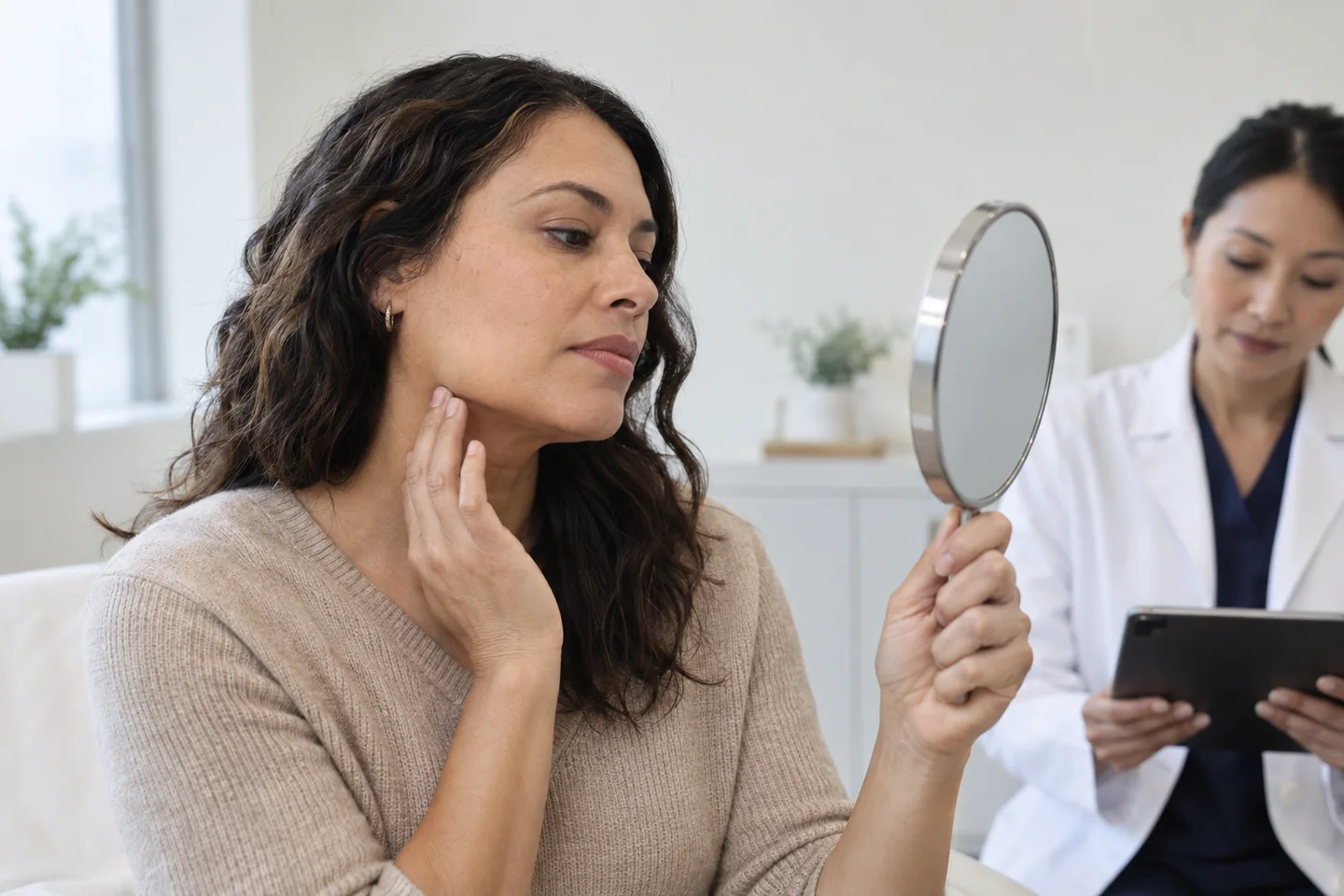
Which non-surgical treatments are used when the jawline skin is loose?
Ultrasound, radiofrequency and laser are the energy types the ASDS lists for non-invasive tightening, and the AAD adds two further device-based routes that involve a wound. The ASDS defines these devices as non-surgical devices used to stimulate collagen production in the deeper layers of the skin, and says that over time they work to shrink tissue that has lost its tone and elasticity. The AAD sets out what each route involves and what it reports about the result (Many ways to firm sagging skin).
| Treatment | What the AAD describes | What the AAD reports about the result |
|---|---|---|
| Ultrasound | Sending heat deep into the skin; the heat can cause the body to produce more collagen | With 1 treatment, most people see modest lifting and tightening within 2 to 6 months; additional treatments may add benefit |
| Radiofrequency (non-invasive) | A device is placed against the skin and heats the tissue beneath | Most people have 1 treatment and feel some tightening right away; best results at about 6 months; results can last 2 to 3 years with the right skin care |
| Laser (non-wounding) | Some lasers send heat deep into the skin without wounding the top layer | 3 to 5 treatments may be needed; results appear gradually between 2 and 6 months after the last treatment |
| Radiofrequency (minimally invasive) | A thin tube or needles is inserted into the skin to heat the tissue beneath | Results usually in about 1 month; in some research studies, gradual tightening for close to 1 year |
| Laser resurfacing | A laser that wounds the top layer of skin; unlike the non-wounding kind, it requires downtime | After healing, tightening and fewer wrinkles within 2 weeks; usually better than any other skin-tightening procedure, with a greater risk of side effects such as scarring |
The ASDS lists the jowls and the neck among the areas where non-invasive tightening is used for laxity, which covers the first three rows. The AAD notes that dermatologists often use the minimally invasive form to tighten the neck or upper arms, and, among the routes that are not surgery, describes laser resurfacing as the most effective procedure for tightening loose skin, with the trade-off that it requires staying home for 5 to 7 days and carries a greater risk of side effects, such as scarring. The AAD also states that none of the device-based routes, minimally invasive ones included, gives the results of a facelift, eyelid surgery, or neck lift.
How does heat-based tightening reach the deeper skin?
The device is held against the surface, and the heat it delivers acts on the deeper layers of the skin. The ASDS describes this shared principle across the energy types: the device delivers heat to the skin tissue, and the collagen production it aims to stimulate is in the deeper layers.
The route differs by energy type. For radiofrequency, the AAD describes a device placed against the skin that heats the tissue beneath. For ultrasound, the energy starts as sound. The National Institute of Biomedical Imaging and Bioengineering (NIBIB) explains that piezoelectric materials inside a transducer produce sound waves when an electric field is applied to them, and that therapeutic ultrasound can focus acoustic output on a target (Ultrasound).
The transducer's geometry and its nominal focal depth answer a narrower design question: where the acoustic waves are arranged to converge. StatPearls describes high-intensity focused ultrasound as using a curved probe surface to create a focal point at a controllable depth (Ultrasound Therapy). A stated focal depth is a device specification, not the name of an anatomical layer, and a curved surface does not establish better contact, greater safety, or a jawline result.
That description has limits that matter here. NIBIB's examples of therapeutic ultrasound are treatments inside the body, such as uterine fibroids and bone metastases, not cosmetic skin tightening. Where a focal region sits relative to the skin surface is a specification of a particular device, and none of the public sources cited in this article state it. Focusing describes where acoustic energy is concentrated, not whether the surrounding tissue is affected, and energy arriving at a focal region is not the same thing as a visible lift. The result figures in this article come from the AAD and the ASDS, who state them for treatment categories rather than for any delivery arrangement.
Which energy type does the clinic use, and which area does it plan to treat? A treatment name containing the word "lifting" answers neither question.
What if the fullness under the chin is fat rather than loose skin?
Fatty tissue under the chin is a different finding from loose skin, and it is not addressed by a skin-tightening device. MedlinePlus notes that sagging jowls may create the look of a double chin in some people, so the appearance from the outside does not by itself separate loose skin from fat (Aging changes in the face). Treatments aimed at the fat itself, whether an injection into the fatty tissue or a surgical procedure, belong to a different category with their own schedules and side effects, and whether one applies is a clinical assessment made in person.
Both findings can be present at once, which is the reason a consultation for a softer jawline usually starts with an examination of what has changed rather than with a procedure name.
How much change can a non-surgical jawline treatment make?
The AAD describes the size of the change from non-invasive tightening as modest, and identifies a small amount of sagging skin as one condition associated with a more favorable result. Its list also includes being at a healthy weight and maintaining it, eating a healthy diet, quitting smoking, drinking little alcohol, protecting the skin from the sun and never tanning indoors. For people who have a lot of sagging skin, the AAD says skin tightening may not be helpful.
The AAD places the options on a range. A surgical lift such as a facelift or eyelid surgery gives the most dramatic results. Among the routes that are not surgery, the AAD describes laser resurfacing as the most effective procedure for tightening loose skin, usually better than any other skin-tightening procedure, and says it also diminishes fine lines, wrinkles and dark spots; the trade-off, in the AAD’s words, is that it requires downtime of 5 to 7 days at home and has a greater risk of possible side effects, such as scarring. At the other end, a cream or lotion cannot lift sagging skin at all, because it cannot penetrate the skin deeply enough to do it. Non-invasive tightening sits between those ends: little or no downtime, and a modest change.
What does recovery look like, and when should you judge the result?
Recovery from non-invasive tightening finishes long before the result is complete. The ASDS reports that patients may have mild swelling, bruising, or redness; swelling or bruising can last 1 to 2 weeks if they occur, redness typically resolves within a few hours, and many patients feel like resuming normal activities later that day or the next. The AAD lists downtime for its non-invasive category as little or none, notes that most of these procedures take an hour or less, and lists some discomfort during the procedure. The ASDS adds that some machines may need topical anesthesia or other means of pain control.
Uncommon effects are listed separately by the ASDS: skin burns, infection, numbness, muscle weakness, inflammatory or allergic reactions, and contour changes.
The result appears on a slower schedule than the recovery. The ASDS says results from tightening procedures that work on collagen stimulation can often take at least 3 to 6 months to show their effect, and that the number of treatments needed varies with the device used, the area treated, the energy source and level, the condition being treated, the age of the patient, and individual patient characteristics.
This article is general information, not medical advice. Whether a treatment suits you, and what it can change, is assessed by a qualified clinician. Treatment suitability, results, and recovery vary between individuals.
Sources
- American Academy of Dermatology. Many ways to firm sagging skin. https://www.aad.org/public/cosmetic/younger-looking/firm-sagging-skin ↗
- American Society for Dermatologic Surgery. Non-invasive Skin Tightening Treatments. https://www.asds.net/skin-experts/skin-treatments/non-invasive-skin-tightening-treatments ↗
- MedlinePlus Medical Encyclopedia, National Library of Medicine. Aging changes in the face. Review date 7/15/2024. https://medlineplus.gov/ency/article/004004.htm ↗
- MedlinePlus Medical Encyclopedia, National Library of Medicine. Aging changes in skin. Review date 7/15/2024. https://medlineplus.gov/ency/article/004014.htm ↗
- National Institute of Biomedical Imaging and Bioengineering. Ultrasound. Updated December 2023. https://www.nibib.nih.gov/science-education/science-topics/ultrasound ↗
- Matthews MJ, Stretanski MF. Ultrasound Therapy. StatPearls [Internet], NCBI Bookshelf. 2023. https://www.ncbi.nlm.nih.gov/books/NBK547717/ ↗
Frequently asked questions
What is the effective non-surgical jawline lifting procedure?
For skin that has lost firmness along the jaw and neck, the non-invasive options are devices that deliver heat with laser, radiofrequency, or ultrasound energy, and the ASDS lists the jowls and neck among the treated areas; fullness under the chin made of fatty tissue is a separate finding that a tightening device does not remove. In a focused-ultrasound device, the transducer's geometry and nominal focal depth describe where acoustic waves are arranged to converge, but those specifications do not by themselves establish a jawline result. The AAD describes the change from non-invasive tightening as modest and, among the routes that are not surgery, names laser resurfacing, which wounds the skin, as the one that tightens loose skin better than any other skin-tightening procedure.
How long does it take to see a result on the jawline?
At least 3 to 6 months for collagen-stimulating tightening, according to the ASDS. The AAD gives 2 to 6 months after 1 ultrasound treatment, about 6 months for the fullest result from non-invasive radiofrequency, 2 to 6 months after the last of 3 to 5 non-wounding laser sessions, and about 1 month for minimally invasive radiofrequency.
Will a non-surgical treatment give the same result as a facelift?
No. The AAD says a surgical lift such as a facelift or eyelid surgery gives the most dramatic results, and that even minimally invasive tightening still cannot give the results of a facelift, eyelid surgery, or neck lift. The AAD describes non-invasive tightening as producing modest lifting and tightening that appears gradually.
How do I tell whether my jawline change is loose skin or fat under the chin?
A clinician makes that assessment in person. MedlinePlus notes that sagging jowls may create the look of a double chin in some people, so the appearance alone does not separate the two. The ASDS describes a medical history and physical examination before non-invasive tightening. Both findings can be present at once.
What are the side effects of non-invasive skin tightening?
The ASDS lists swelling, bruising, and redness as common, with swelling or bruising lasting 1 to 2 weeks if they occur and redness typically resolving within a few hours. The AAD lists some discomfort during the procedure, and says there is little risk of other side effects when the procedure is performed by a board-certified dermatologist; that statement is the AAD's and is conditioned on who performs it. Uncommon effects on the ASDS list are skin burns, infection, numbness, muscle weakness, inflammatory or allergic reactions, and contour changes.
This content is for general information only and does not guarantee the results of any treatment. Any treatment decision should be made in consultation with a qualified medical professional.