What Causes Skin Laxity, and What Actually Improves It

Key Takeaways
- Every layer of the skin contains connective tissue with collagen fibers for support and elastin fibers for flexibility and strength. When that tissue changes, the skin's strength and elasticity fall, which MedlinePlus calls elastosis.
- Sun exposure is the greatest single factor in how the skin ages, and the effect is visible when you compare a regularly exposed area with a covered one.
- The subcutaneous fat layer thins with age, so there is less padding under the skin. MedlinePlus lists this as a separate aging change from the loss of collagen and elastin.
- A moisturizer can plump the skin temporarily and make fine lines less noticeable, but the AAD says a cream or lotion cannot penetrate the skin deeply enough to lift sagging skin. A retinoid may produce a small change because it can help the body make more collagen.
- In-office options differ in how much they change and what they cost in recovery. The AAD puts non-invasive ultrasound at a modest result within 2 to 6 months after a single treatment, non-invasive radiofrequency at its best result in about 6 months, and non-wounding laser at 2 to 6 months after the last of 3 to 5 treatments; minimally invasive options need sedation and a few days at home; a surgical lift gives the most dramatic result.
Skin laxity is the loss of firmness you notice along the jawline, at the lower cheeks, on the neck, or on the upper arms. It has several causes at once, and what can change it depends on which of those causes is largest in your case.
The skin loosens because the connective tissue that supports it loses strength and elasticity. Age accounts for part of that; among the factors that act on the skin, sun exposure is the single largest one. What can improve it depends on how much loose skin there is. Daily sun protection limits further damage, a retinoid may make a small difference, and the American Academy of Dermatology (AAD) describes in-office non-invasive tightening as a modest change that appears over months. For a lot of sagging skin, the AAD says tightening may not help.
What is skin laxity, and what is changing underneath?
It is a loss of firmness in the connective tissue of the skin, and it appears alongside a loss of padding beneath it. MedlinePlus describes the skin in three main parts, the epidermis, the dermis, and the subcutaneous layer, and notes that each layer also contains connective tissue with collagen fibers to give support and elastin fibers to provide flexibility and strength (Aging changes in skin). It lists changes in the connective tissue that reduce the skin's strength and elasticity, which is called elastosis. Separately, it lists the subcutaneous fat layer thinning, so the skin has less insulation and padding. MedlinePlus records both as aging changes; the firmness loss belongs to the connective tissue, and the thinner fat layer is a change in what sits beneath it.
The National Institute on Aging describes the same loss from the other direction: age-related changes such as a loss of elastic fibers, or elastin, and of collagen make the skin look older, develop wrinkles, and become more fragile (Skin Care and Aging). Looseness that comes from the tissue under the surface is a different problem from a line in the surface, and a product that improves the surface does not address the support.
Why does skin lose firmness faster in some people?
Because the amount of ultraviolet exposure the skin has taken differs from person to person, and MedlinePlus names sun exposure as the greatest single factor in how skin ages. MedlinePlus lists environmental factors, genetic makeup, and nutrition among the causes of skin aging and then states that the greatest single factor is sun exposure. It also gives a way to see this for yourself: compare an area of your body that gets regular sun with an area that stays covered.
The cumulative nature of that damage is what makes it uneven between people. The NIA explains that ultraviolet light damages skin cells, that a short exposure can cause a sunburn, and that over time UV damage adds up and leads to changes in skin texture, premature skin aging, and wrinkles. MedlinePlus adds that elastosis is more noticeable in sun-exposed areas, where it is called solar elastosis, and that it produces the leathery, weather-beaten appearance seen in people who spend a large amount of time outdoors.
- Pigment. MedlinePlus notes that natural pigments appear to give some protection against sun-induced damage, and that fair-skinned, blue-eyed people show more aging skin changes than people with darker, more heavily pigmented skin.
- Hormonal change. The NIA says hormonal changes such as those that occur with menopause can make the skin thinner and drier. MedlinePlus adds that women gradually produce less oil beginning after menopause, while in men the decrease is minimal and usually comes after the age of 80.
- Everyday exposures. The NIA lists drinking too little water, spending too much time in the sun, living in a dry environment, and smoking among the causes of dry, rough skin in older adults.
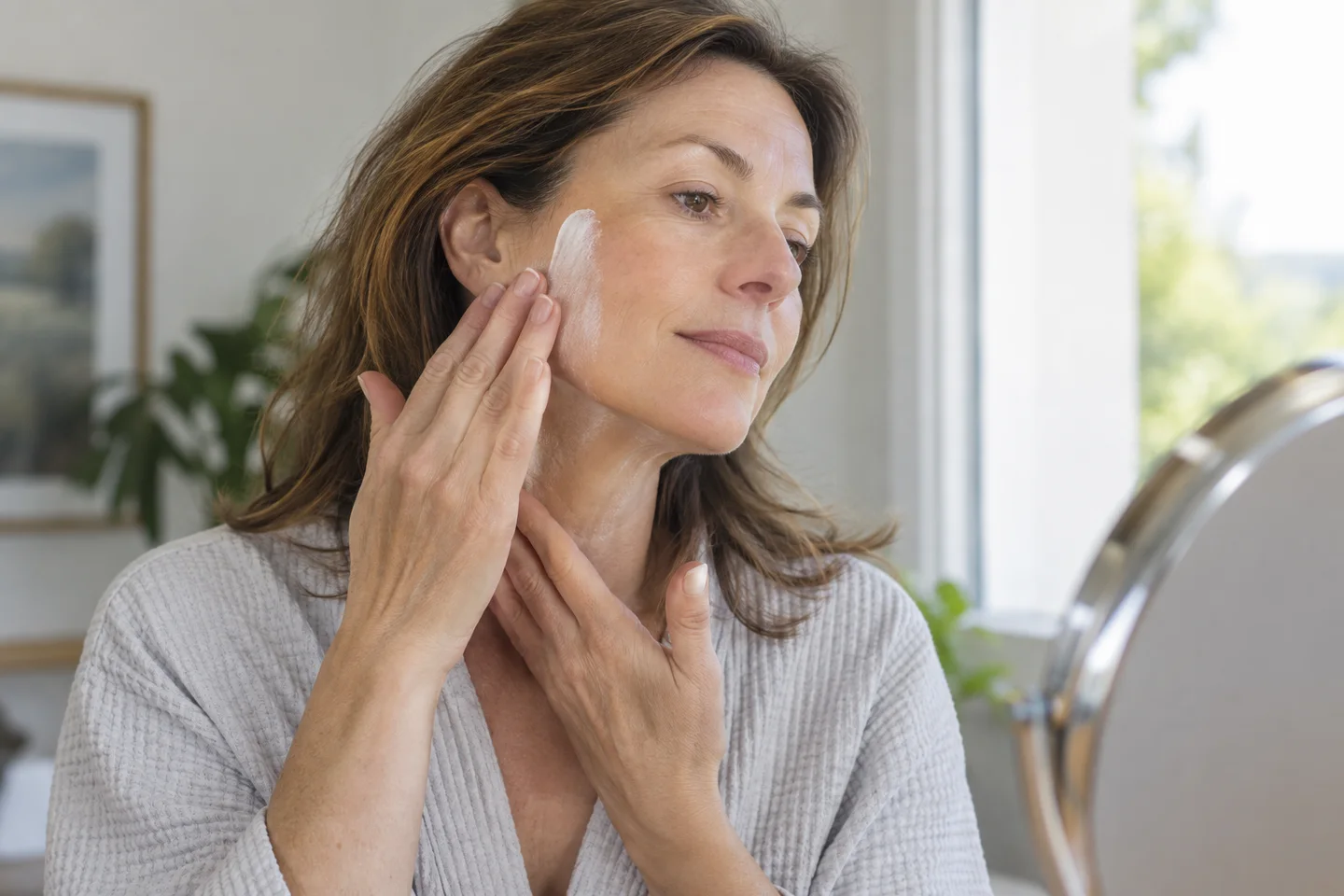
Is loose skin the same as dry skin or a wrinkle?
No. Each of the three is a different change, and a product or procedure that helps one of them does not help the others. Dryness comes largely from reduced oil production: MedlinePlus says sebaceous glands produce less oil with age, which makes it harder to keep the skin moist and leads to dryness and itchiness. Laxity is a loss of firmness in the tissue underneath. A wrinkle is a crease in the surface. All three can be present in the same area of the face without being the same change.
The AAD says that when you see an immediate result from a skin-firming product, the product tends to be an effective moisturizer, and that a good moisturizer can plump up your skin and make fine lines and wrinkles less noticeable, though the result is temporary and depends on applying the product every day (Many ways to firm sagging skin). On lifting sagging skin, the same page is direct: dermatologists say that is not possible, because a cream or lotion cannot penetrate the skin deeply enough to do it.
Can anything you do at home firm loose skin?
Sun protection limits further damage, and a retinoid may add a small change; nothing applied at home lifts skin that has already loosened. MedlinePlus puts prevention first: because most skin changes are related to sun exposure, prevention is a lifelong process. Its advice is to use a good quality sunscreen outdoors even in winter and to wear protective clothing and a hat when needed. The NIA gives the specifics:
- sunscreen of SPF 15 or higher, labeled broad spectrum;
- applied 15 to 30 minutes before going outside, and reapplied at least every two hours, more often when swimming or sweating;
- staying out of the strongest sun, which in summer it gives as 10 a.m. to 4 p.m.;
- no sunlamps or tanning beds.
For firmness itself, the ceiling is low. The AAD says the results you see from a skin-firming cream will be subtle at best and that it is possible you will see none, but it also notes one exception: you may see a small change if a product contains a retinoid, such as retinol, which can help your body make more collagen. A moisturizer manages dryness and can make fine lines less noticeable for as long as it is applied; it does not act on the tissue that has loosened.
What can an in-office procedure change, and by how much?
The AAD describes the non-invasive procedures as producing a modest change, the minimally invasive ones as producing more at the cost of a wound and downtime, and a surgical lift as producing the most dramatic result. The table follows the AAD's descriptions.
| Group | What is done, according to the AAD | When the result appears, according to the AAD | Recovery, according to the AAD |
|---|---|---|---|
| Non-invasive ultrasound | Heat is sent deep into the skin from the surface; the heat can cause the body to produce more collagen | Most people see modest lifting and tightening within 2 to 6 months after 1 treatment; additional treatments may add benefit | The skin stays intact, with no puncture wound, incision, or raw skin; downtime little or none |
| Non-invasive radiofrequency | A device is placed against the skin and heats the tissue beneath | Some tightening is felt right away; the result develops over about 6 months; some people benefit from more than 1 treatment | The skin stays intact, with no puncture wound, incision, or raw skin; downtime little or none |
| Non-invasive laser | Heat is sent deep without wounding the top layer of skin; also used on loose skin on the belly and upper arms | 3 to 5 treatments may be needed, with results appearing gradually 2 to 6 months after the last one | The skin stays intact, with no puncture wound, incision, or raw skin; downtime little or none |
| Minimally invasive radiofrequency | A thin tube or needles is inserted so heat is delivered where it is needed | Usually about 1 month; in some research studies, gradual tightening for close to 1 year | Sedation, a few days of downtime, a compression garment for 4 or 5 days, and wound care |
| Laser resurfacing | A laser that wounds the top layer of skin, unlike the non-wounding laser above | Tightening and fewer wrinkles within 2 weeks of healing | 5 to 7 days at home and a greater risk of side effects such as scarring |
| Surgical lift | Facelift, eyelid surgery, or neck lift | The most dramatic result | The longest recovery |
Among the routes that are not surgery, the AAD describes laser resurfacing as the most effective procedure for tightening loose skin, usually better than any other skin-tightening procedure, and in the same section says that none of the minimally invasive procedures gives the results of a facelift, eyelid surgery, or neck lift.
Where the energy is delivered is what separates an in-office procedure from a product applied at home. For ultrasound, StatPearls describes the transducer as converting an electrical signal into sound waves through piezoelectric crystals, and describes the beam as narrowing to a focal zone before widening again (Ultrasound Physics and Instrumentation). In high-intensity focused ultrasound, StatPearls states, the probe has a curved surface, which creates a focal point of the waves at a controllable depth (Ultrasound Therapy). That is the structural difference from a cream: a cream stays at the surface where it was applied, and a focused ultrasound treatment is arranged so that the energy converges below it. None of that describes how much tightening follows, and none of it means tissue outside the focal point is unaffected; the size of the change is still the modest one the AAD reports, judged months later. Radiofrequency and laser deliver heat by different routes, which the table describes.
The time to the result is not the same as the time to the appointment. Collagen takes time to form, which is why a treatment done in an afternoon is judged months later.
When is skin tightening not the answer?
When there is a lot of sagging skin. The AAD lists conditions associated with a more favorable result: being at a healthy weight and maintaining it, eating a healthy diet, quitting smoking, drinking little alcohol, protecting your skin from the sun and never tanning indoors, and having a small amount of sagging skin. It then states the limit directly: if you have lots of sagging skin, skin tightening may not be helpful, and a surgical lift is what it describes as giving the most dramatic results.
Whether a procedure is appropriate at all, including during pregnancy, with a skin infection, or while taking certain medications, is assessed by a qualified clinician; the AAD names those three situations without naming the medications.
This article is general information, not medical advice. Whether a treatment is suitable, and what result it produces, is assessed by a qualified clinician. Treatment suitability, results, and recovery vary between individuals.
Sources
- A.D.A.M. Aging changes in skin. MedlinePlus Medical Encyclopedia, U.S. National Library of Medicine. Review date 7/15/2024. https://medlineplus.gov/ency/article/004014.htm ↗
- National Institute on Aging. Skin Care and Aging. Content reviewed February 11, 2025. https://www.nia.nih.gov/health/skin-care/skin-care-and-aging ↗
- American Academy of Dermatology. Many ways to firm sagging skin. https://www.aad.org/public/cosmetic/younger-looking/firm-sagging-skin ↗
- Grogan SP, Mount CA. Ultrasound Physics and Instrumentation. StatPearls [Internet], NCBI Bookshelf. 2023. https://www.ncbi.nlm.nih.gov/books/NBK570593/ ↗
- Matthews MJ, Stretanski MF. Ultrasound Therapy. StatPearls [Internet], NCBI Bookshelf. 2023. https://www.ncbi.nlm.nih.gov/books/NBK547717/ ↗
Frequently asked questions
What causes skin laxity and how can it be improved?
Skin loosens because the connective tissue that supports it loses strength and elasticity, with sun exposure as the largest single factor, and it is improved by sun protection and a retinoid at home and by in-office tightening with ultrasound, radiofrequency or laser, which the AAD describes as a modest change. MedlinePlus calls the connective-tissue change elastosis and names sun exposure as the greatest single factor in skin aging. In a focused-ultrasound device, a transducer converts an electrical input into sound waves and arranges them to converge at a nominal focal depth; that is a delivery feature, not a promise about how much tightening will follow. In the office, the AAD describes non-invasive ultrasound, radiofrequency, and non-wounding laser as producing modest tightening over months, minimally invasive options as producing more at the cost of a wound and a few days of recovery, and a surgical lift as producing the most dramatic result.
Can a cream or serum tighten loose skin?
No. The AAD states that dermatologists say lifting sagging skin with a cream or lotion is not possible, because a cream or lotion cannot penetrate the skin deeply enough. What a good moisturizer does is plump the skin temporarily so fine lines and wrinkles are less noticeable, and that effect lasts only while you keep applying it. The exception the AAD names is a retinoid such as retinol, which can help the body make more collagen and may produce a small change.
Why does a tightening procedure take months to show a result?
Because the change the AAD describes comes from collagen the body produces after the heat is delivered, and collagen takes time to form. That is why a single appointment is judged months later rather than the next day, and why the AAD gives different timelines for different routes: 2 to 6 months after one ultrasound treatment, about 6 months for a non-invasive radiofrequency result to develop, and 2 to 6 months after the last of 3 to 5 non-wounding laser treatments. Minimally invasive radiofrequency and laser resurfacing, which involve a wound, are the routes the AAD describes as showing results sooner.
Why does sun exposure matter so much for firmness specifically?
Because the tissue that ultraviolet damage accumulates in is the same tissue that keeps the skin firm. MedlinePlus says elastosis, the loss of strength and elasticity in connective tissue, is more noticeable in sun-exposed areas, where it is called solar elastosis and produces a leathery appearance. The NIA describes UV damage as adding up over time and leading to changes in skin texture, premature skin aging, and wrinkles. Protection remains useful after looseness has appeared, because it acts on further damage, not on what has already occurred.
When is skin tightening not the right option?
When there is a lot of sagging skin. The AAD says you are likely to benefit most with a small amount of sagging skin, and that if you have lots of sagging skin, skin tightening may not be helpful; a surgical lift is what it describes as giving the most dramatic results. The AAD also names pregnancy, a skin infection, and certain medications as situations in which a skin-tightening procedure is not right, and whether any of them applies is assessed at the consultation.
This content is for general information only and does not guarantee the results of any treatment. Any treatment decision should be made in consultation with a qualified medical professional.