Loose, Sagging Skin: What Has Changed Underneath, and How It Is Assessed

Key Takeaways
- A 2013 review in Plastic and Reconstructive Surgery Global Open describes changes in the facial skeleton, the soft tissue, the retaining ligaments, the fat compartments, and the skin, which contribute to facial aging "in variable degrees."
- Mayo Clinic describes the skin of the aging face as becoming looser and less able to return to its shape when stretched, with less fat in some areas and more in others, which may make the face sag.
- A 2025 review describes the facial retaining ligaments weakening and stretching with age, which it links to fat pad descent, increased skin laxity, jowls, deeper nasolabial folds, and bands in the neck, while noting that their exact role is still debated.
- Cleveland Clinic explains that skin that stretched to accommodate extra weight loses elasticity and, after major weight loss, may hang loosely from the body because it cannot conform to the new shape.
- In skin research, sagging can be graded on standardized photographs with clinical skin aging scales, and skin elasticity can be measured with a suction device.
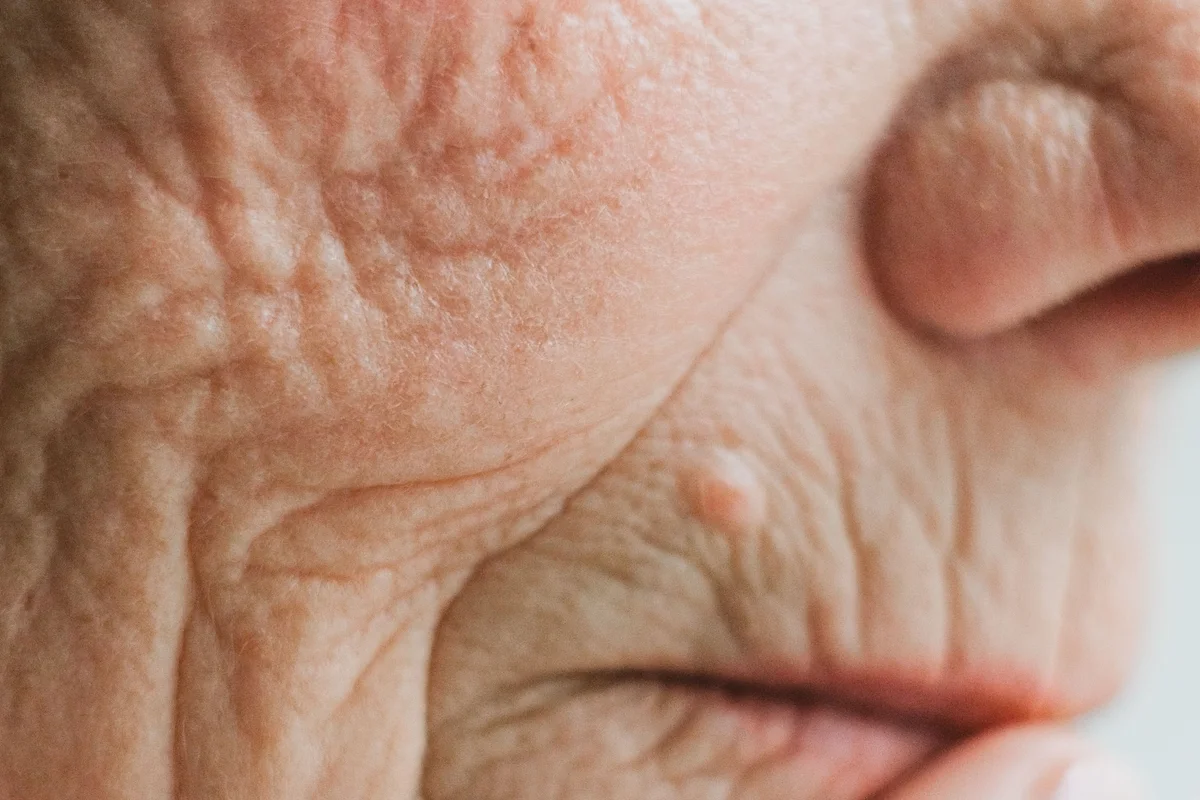
Skin that feels loose and skin that sags can come from different changes. Loose skin reflects a change in the skin itself, which becomes less elastic. Sagging also involves the tissue beneath it: the fat, the ligaments that hold the soft tissue in place, and the bone that supports these tissues all change with age, and fat volume can also decrease after major weight loss.
Which treatment fits loose, sagging skin depends on which tissue has changed (the skin, the fat, the ligaments, or the bone) and by how much. A 2013 review of facial aging calls an appropriate diagnosis of the changes in each of these tissues imperative to planning rejuvenation.
What treatment suits skin that feels loose and is sagging?
Each procedure acts on particular tissues, while loose, sagging skin can involve the skin, the fat and ligaments beneath it, and the bone, so no single treatment suits every case. The 2013 review of facial aging concludes that changes to the facial skeleton, soft tissue, retaining ligaments, fat compartments, and skin envelope all contribute to facial aging in variable degrees, depending on intrinsic and extrinsic factors (The Science and Theory behind Facial Aging).
Surgery is one category of treatment: the American Society of Plastic Surgeons (ASPS) describes a facelift as a surgical procedure for visible signs of aging in the face and neck, such as relaxation of the skin of the face causing sagging, fat that has fallen or disappeared, and jowls (Facelift Surgery). For non-surgical treatments, Skin Tightening and Lifting in Your 50s sets out how the American Academy of Dermatology groups them and what it says about the amount of sagging.
Tissue changes behind loose, sagging skin
Several tissues can change: the skin loses elasticity, the fat beneath the skin shrinks or shifts, the ligaments that hold the soft tissue in place weaken, and the facial bone remodels. Mayo Clinic describes the skin and fat changes: with age, the skin "gets looser and doesn't snap back as easily when stretched," and there is less fat in some areas of the face and more in others, which may cause the face to sag and look tired and heavy (Face-lift).
The 2013 review of facial aging describes the fat of the face as lying in separate superficial and deep compartments; with age, the midfacial fat compartments lose volume and move downward. The review states that weakening of the retaining ligaments, the connective tissue bands that hold the soft tissue in place, "gives the appearance of descent of the facial soft tissue," and that the facial skeleton itself remodels over a lifetime. A 2025 review of the retaining ligaments in the Journal of Personalized Medicine adds that aging causes these ligaments to weaken and stretch, leading to fat pad descent, increased skin laxity, jowls, deepening nasolabial folds, and bands in the neck (platysmal banding). The 2025 review also notes that the exact role of the ligaments in facial aging remains debated. It adds that the number, density, and arrangement of the ligaments in the upper cheek vary between individuals (Retaining Ligaments of the Face: Still Important in Modern Approach in Mid-Face and Neck Lift?).
The 2013 review of facial aging calls the skin the "envelope or canvas" of the face: the skin reveals the volume loss and atrophy of the bone and soft tissue beneath it, and it also goes through changes of its own over time, from both external and internal factors. The review describes smoking and sun damage producing epidermal thinning, solar elastosis, and disorganized dermal collagen. What Causes Skin Laxity, and What Actually Improves It explains these skin-level changes and the role of sun exposure in more detail.
Radiofrequency devices used on the skin's surface deliver energy through a tip that rests on the skin, and tips are not all the same size. A 2009 dermatology review describes a monopolar system used with disposable treatment tips in two sizes of treatment area, along with a conductive coupling fluid used to enhance thermal and electrical contact between the tip and the skin (Cutaneous remodeling and photorejuvenation using radiofrequency devices). During treatment, the part of a tip that touches the skin is not necessarily the whole area it is designed to cover. Tip size and how fully a tip stays in contact with the skin are device details relevant to the choice among radiofrequency treatments.
Loose skin after major weight loss
Skin can hang loose after major weight loss because skin that stretched to cover a larger body loses elasticity and cannot fully conform to a smaller one, according to Cleveland Clinic. Cleveland Clinic explains that when a person carries extra weight, the skin and tissue stretch to accommodate the body's larger size, and this stretching causes them to lose elasticity. After weight loss, it says, the stretched skin cannot conform to the new shape and may be saggy and hang loosely from the body (Excess Skin Removal: What It Is, Surgery, Procedures & Recovery).
Massive weight loss is also associated with changes in the face. A 2024 systematic review published in Aesthetic Surgery Journal Open Forum found that massive weight loss was associated with features that resemble facial aging: volume loss in the midface was the most significant volumetric change, followed by skin laxity under the chin, and apparent age was higher among patients with massive weight loss (Soft Tissue Facial Changes Following Massive Weight Loss Secondary to Medical and Surgical Bariatric Interventions: A Systematic Review).
Sagging grades and elasticity measurements in skin research
In skin research, sagging is graded on standardized photographs with clinical skin aging scales, and skin elasticity is measured with a suction device. A 2015 study in BioMed Research International notes that numerous clinical skin aging scales are used in skin research and aesthetic dermatology, with wrinkles, pigment changes, and sagging among their most important items. In that study, sagging was graded on standardized photographs of the face taken from the front and at 45 degrees to each side (Characterizing Facial Skin Ageing in Humans: Disentangling Extrinsic from Intrinsic Biological Phenomena).
A suction device draws the skin into a probe under a set negative pressure and records how far the skin rises and how much of that rise recovers when the suction is released. A 2013 review of skin viscoelasticity in Biological Research for Nursing describes these measurements, including a ratio of elastic recovery to elastic deformation, and notes that aging and sun exposure can reduce the skin's viscoelasticity (Skin Viscoelasticity: Physiologic Mechanisms, Measurement Issues, and Application to Nursing Science). In the 2015 study of 24 women, the skin's remaining deformation after suction was associated with the sagging grade on both cheeks after accounting for age.
Sources
- Farkas JP, Pessa JE, Hubbard B, Rohrich RJ. The Science and Theory behind Facial Aging. Plastic and Reconstructive Surgery Global Open. 2013;1(1):e8-e15. https://pmc.ncbi.nlm.nih.gov/articles/PMC4174174/ ↗
- American Society of Plastic Surgeons. Facelift Surgery. https://www.plasticsurgery.org/cosmetic-procedures/facelift ↗
- Mayo Clinic. Face-lift. https://www.mayoclinic.org/tests-procedures/face-lift/about/pac-20394059 ↗
- Tarallo M, Cilluffo M, Papa F, Fanelli B. Retaining Ligaments of the Face: Still Important in Modern Approach in Mid-Face and Neck Lift? Journal of Personalized Medicine. 2025;15(12):582. https://pmc.ncbi.nlm.nih.gov/articles/PMC12734016/ ↗
- Cleveland Clinic. Excess Skin Removal: What It Is, Surgery, Procedures & Recovery. Last updated 11/01/2021. https://my.clevelandclinic.org/health/treatments/22017-excess-skin-removal ↗
- Jafar AB, Jacob J, Kao WK, Ho T. Soft Tissue Facial Changes Following Massive Weight Loss Secondary to Medical and Surgical Bariatric Interventions: A Systematic Review. Aesthetic Surgery Journal Open Forum. 2024;6:ojae069. https://pmc.ncbi.nlm.nih.gov/articles/PMC11427949/ ↗
- Trojahn C, Dobos G, Lichterfeld A, Blume-Peytavi U, Kottner J. Characterizing Facial Skin Ageing in Humans: Disentangling Extrinsic from Intrinsic Biological Phenomena. BioMed Research International. 2015;2015:318586. https://pmc.ncbi.nlm.nih.gov/articles/PMC4341846/ ↗
- Everett JS, Sommers MS. Skin Viscoelasticity: Physiologic Mechanisms, Measurement Issues, and Application to Nursing Science. Biological Research for Nursing. 2013;15(3):338-346. https://pmc.ncbi.nlm.nih.gov/articles/PMC3465619/ ↗
- Elsaie ML. Cutaneous remodeling and photorejuvenation using radiofrequency devices. Indian Journal of Dermatology. 2009;54(3):201-205. https://pmc.ncbi.nlm.nih.gov/articles/PMC2810682/ ↗
Frequently asked questions
My skin feels loose and is sagging. What would be the most effective treatment for this?
No single treatment suits every case of loose, sagging skin, because the skin, the fat compartments, the retaining ligaments, and the bone can each be involved and each procedure acts on particular tissues; one option is radiofrequency delivered from the skin's surface. A 2013 review of facial aging states that these tissues contribute to facial aging in variable degrees and calls an appropriate diagnosis of the changes in each of them imperative. According to a 2009 dermatology review, radiofrequency current flows through the tissue, and heat is produced as the current meets the tissue's resistance. In the monopolar systems that review describes, the current enters through a single point of contact on the skin and returns through a grounding pad that completes the circuit. The tips that rest on the skin also come in different sizes, a difference to note before deciding on a treatment.
Why does skin sag as we age?
Skin sags with age because of changes in several tissues: the skin becomes looser and less elastic, facial fat decreases in some areas and increases in others, and the retaining ligaments that hold the soft tissue in place weaken and stretch. Mayo Clinic describes the skin and fat changes, and a 2025 review links weakening ligaments to fat pad descent, skin laxity, jowls, and deeper nasolabial folds.
Why does skin stay loose after losing a lot of weight?
According to Cleveland Clinic, skin on the body that stretched to accommodate extra weight loses elasticity, so after weight loss it cannot conform to the new shape and may hang loosely. In the face, a 2024 systematic review found that massive weight loss was associated with midface volume loss and skin laxity under the chin.
How is loose, sagging skin measured?
Clinical skin aging scales, which a 2015 study notes are used in skin research and aesthetic dermatology, include sagging among their main items, and in that study sagging was graded on standardized photographs. In research, skin elasticity is measured with a suction device that records how far the skin rises into a probe and how much of that rise recovers when the suction is released.
Is loose skin the same as sagging skin?
Not exactly. Mayo Clinic describes skin that gets looser and returns to its shape less easily when stretched, a change in the skin itself, while a 2025 review links weakening and stretching of the retaining ligaments beneath the skin to fat pad descent, jowls, and increased skin laxity. The two can appear together; a 2013 review of facial aging states that the skin, fat, ligaments, and bone contribute to facial aging "in variable degrees."
This content is for general information only and does not guarantee the results of any treatment. Any treatment decision should be made in consultation with a qualified medical professional.