Preventing Nasolabial Folds in Your Late 30s: What Slows Them Down

Key Takeaways
- Cleveland Clinic lists aging, smoking, sun damage, and weight change as the leading causes of nasolabial folds. In younger skin the fold appears only when you smile; over time it can stay visible at rest.
- Once a fold has begun to stay at rest, the in-office category to ask about first is non-invasive skin tightening. Cleveland Clinic lists skin-tightening procedures with lasers, ultrasound, or radio waves among its treatments for the fold and says radiofrequency tightening suits younger people who are just starting to show signs of aging; the American Academy of Dermatology (AAD) puts the result at modest, gradual tightening.
- The fold sits on a curved, mobile part of the face, so for surface treatments, tip contact is a practical question: ask how the contact surface is shaped for the area and whether the tip head can move to follow it.
- The habits the AAD recommends to slow premature aging apply directly: daily broad-spectrum sunscreen, no tanning, and stopping smoking. Cleveland Clinic says applying a retinoid can promote collagen production and reduce smile lines over time.
- Cleveland Clinic says there is no way to prevent nasolabial folds for good, and it lists in-office options as treatments for a fold that has formed rather than as prevention.
In your late thirties the fold is often still a smile line that has begun to linger at rest, and what you can do about it runs on two tracks: the in-office tightening category for a fold that has started to stay, and the daily habits that slow the causes behind it.
What turns a smile line into a nasolabial fold: volume loss and collagen with facial aging
Volume loss in the bone and fat under the cheek and a change in the skin above the fold, as well as in the skin of the fold itself. Cleveland Clinic describes the leading causes: as you age, your cheekbones can flatten and gravity can pull down loose skin in the area, and you also have less collagen and elastin, the substances that give skin its elasticity and its ability to hold its shape (Nasolabial Folds (Smile Lines)). Smoking destroys collagen and elastin, the sun's rays break them down, and both losing a lot of weight and gaining it can accentuate the folds.
Cleveland Clinic's page also describes how a smile line becomes a fold. When you are younger, the folds may appear only when you smile or laugh and then disappear as your face relaxes, but over time the lines can become deep, lasting wrinkles that appear whether you are smiling or not.
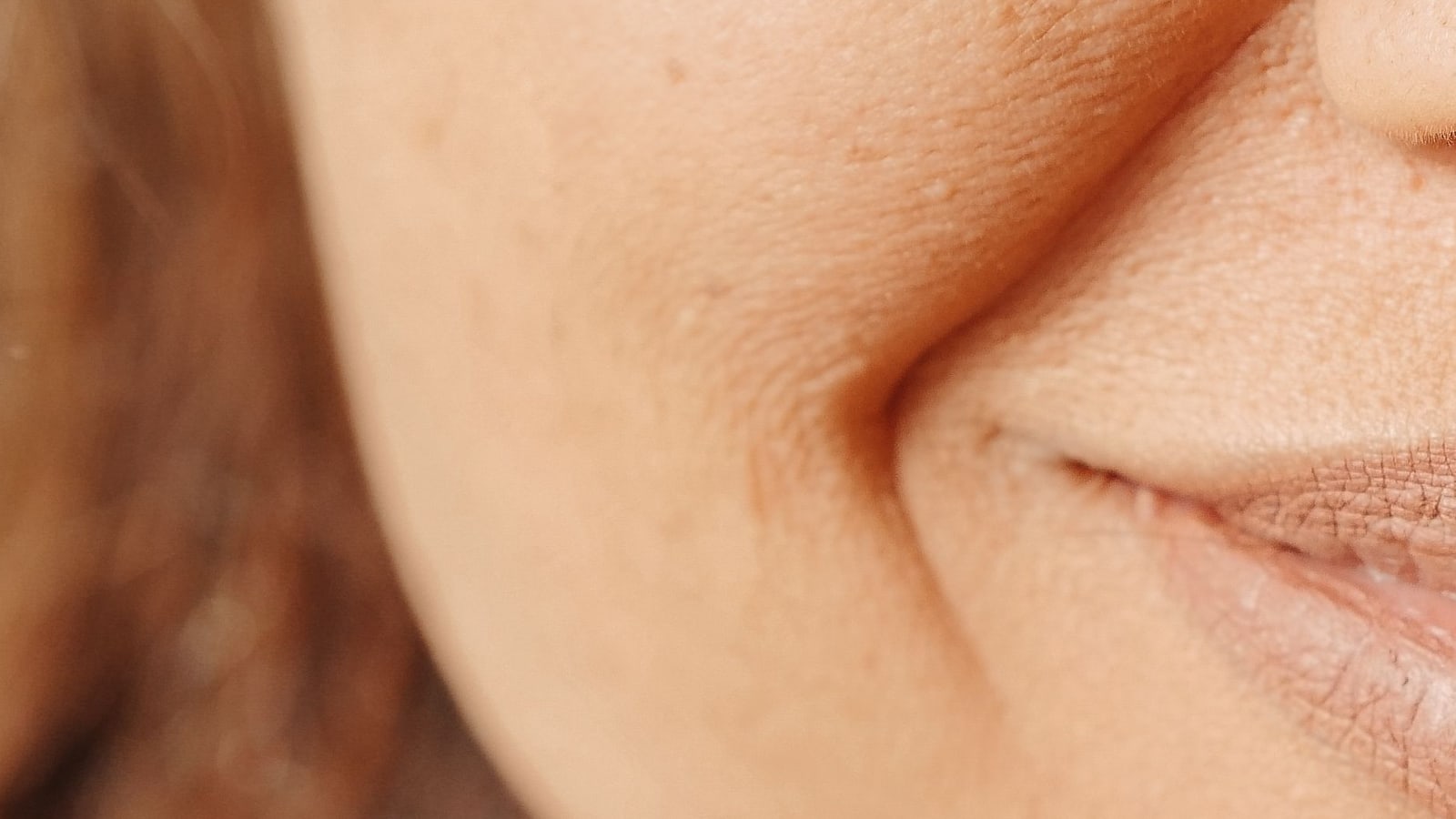
MedlinePlus, the National Library of Medicine's patient encyclopedia, adds the change underneath the skin: with age, the subcutaneous fat layer thins so it has less insulation and padding (Aging changes in skin). Less fat under the cheek and less firmness in the skin above it are why a fold that used to disappear when the face relaxed now remains visible.
What can you do in your late 30s to slow the folds?
Once a fold has begun to stay visible at rest, the in-office option to ask about first is non-invasive skin tightening: Cleveland Clinic lists skin-tightening procedures with lasers, ultrasound, or radio waves among its treatments for nasolabial folds, and says radiofrequency tightening suits younger people who are just starting to show signs of aging (Radio Frequency (RF) Skin Tightening: Benefits & Dangers). The AAD's expected result for that category is modest, gradual tightening (Many ways to firm sagging skin). Alongside any of it run the habits that act on the causes Cleveland Clinic lists, daily sun protection, not smoking, and a retinoid, and Cleveland Clinic states that there is no way to prevent the folds for good (Nasolabial Folds (Smile Lines)).
Which in-office options are discussed once a fold starts to stay?
Cleveland Clinic lists five categories of treatment for a fold that has formed, and skin tightening is the one that works on loose skin rather than on the muscle or the crease. They are botulinum toxin injections to weaken and relax a specific muscle that contributes to the fold, with results lasting a few months; dermal fillers that plump the crease, lasting six months to a year; retinoids; skin-tightening procedures with lasers, ultrasound, or radio waves, which it says can help stimulate collagen production and make loose skin tauter; and surgery, such as a cheek lift or facelift, to reposition skin and underlying tissue.
The AAD's guidance on skin tightening describes the limits of the non-invasive energy treatments: they give modest tightening and lifting, results appear gradually over months, and they are suited to a small amount of sagging rather than a lot (Many ways to firm sagging skin). For a fold that has only recently become visible at rest, the AAD's description of modest, gradual tightening is the expected size of result from this category.
The fold also sits on a curved, mobile part of the face, which matters for the surface treatments in that list. A radiofrequency tip is designed to deliver energy through its contact surface, so it needs full contact with the skin. A review of radiofrequency physics describes devices that monitor contact continuously and shut off automatically when the handpiece is not in full contact, which the review says is meant to stop arcing, which the patient feels as a static shock (Physics of fractional microneedle radiofrequency – A review). Two questions are worth asking here: how the contact surface is shaped for a curved area, and whether the tip head can move to follow the contour beside the nose and mouth. Neither is evidence that a treatment improves the fold; the AAD's "modest" is still the size of result to expect. On a curve, though, how the tip keeps contact is a fair question for the clinic.
Recovery for each of those categories, and how many days people typically plan for, is covered in our separate article on nasolabial fold treatment downtime and recovery.
Nasolabial folds prevention with sunscreen and a retinoid: which daily habits slow photoaging?
Daily sun protection, no tanning, not smoking, and a retinoid; each acts on a cause Cleveland Clinic lists. They are also central to the AAD's guidance on preventing premature skin aging, the sun-driven part of which is called photoaging (11 ways to reduce premature skin aging).
- Sun protection. The AAD says the sun plays a major role in prematurely aging skin and recommends shade, protective clothing, and a broad-spectrum, water-resistant sunscreen of SPF 30 or higher on all exposed skin every day; Cleveland Clinic says to wear SPF 30 daily and reapply every two hours.
- No tanning. The AAD says every tan, from the sun or a tanning bed, prematurely ages the skin, and suggests self-tanner instead.
- Stop smoking. The AAD says smoking greatly speeds up how quickly skin ages; Cleveland Clinic says smoking destroys collagen and elastin.
- A retinoid. Cleveland Clinic says applying a retinoid, a form of vitamin A, can promote collagen production and reduce smile lines over time; the AAD notes that a retinoid can help the body make more collagen, and that prescription-strength products may sting.
- Weight, sleep, diet. Cleveland Clinic names weight loss and weight gain as causes that accentuate the folds, and lists a healthy diet, regular exercise, enough sleep, and sleeping on your back among ways to reduce the risk.
The AAD also notes that it is never too late to benefit: by protecting your skin from the sun, you give it a chance to repair some of the damage, and smokers who stop often notice their skin looks healthier.
Does treating a fold early change how it develops?
The published patient guidance does not claim that it does. Cleveland Clinic states that there is no way to prevent nasolabial folds for good, and that treatments can work for a few months or even years but cannot stop the signs of aging. None of the sources reviewed for this article describes an in-office treatment in the thirties as delaying the fold that would otherwise form.
The sources do support the habits in the list above: sun protection, no tanning, not smoking, and a retinoid. The AAD says it is never too late to benefit from sun protection and stopping smoking, and starting them earlier means less damage accumulates to repair. Whether a specific treatment now would change your face later is something the general guidance does not say; ask a clinician with your own photographs.
Who ages faster, and how to see it on your own face
The habits above are the general answer. The same sources say the rate itself is not the same for everyone, and they give you a way to see your own.
MedlinePlus lists environmental factors, genetic makeup, and nutrition among the causes of aging skin, then singles one out: the greatest single factor is sun exposure. It says you can see this by comparing areas of your body that have regular sun exposure with areas that are protected from sunlight. That is a check you can do today. It adds that natural pigments seem to provide some protection against sun-induced damage, and that blue-eyed, fair-skinned people show more aging skin changes than people with darker, more heavily pigmented skin. For the same reason it calls prevention a lifelong process and says to use a good quality sunscreen outdoors even in the winter.
Two of the AAD's 11 ways to reduce premature skin aging apply to this fold in particular. One is expression: when you make a facial expression you contract the underlying muscles, and the AAD says repeatedly contracting the same muscles for many years makes those lines lasting; the one concrete step it gives under that heading is sunglasses, to reduce the lines caused by squinting. The other is irritation: the AAD says scrubbing your skin clean can irritate it, and that irritating your skin accelerates skin aging, so it puts washing at twice a day and after sweating heavily. Cleveland Clinic's own prevention list for this fold says the same from the other side: do not use anything on your skin that stings or burns unless a healthcare provider prescribed it, because irritation can enhance the signs of aging.
None of this changes what the fold is. It changes how fast the causes Cleveland Clinic lists act on your face, and it is the part of the answer that differs from one person to the next.
This article is general information, not medical advice. Treatment suitability and results vary between individuals and are assessed by a qualified clinician.
Sources
- Cleveland Clinic. Nasolabial Folds (Smile Lines). Last updated 05/18/2022. https://my.clevelandclinic.org/health/diseases/23027-nasolabial-folds ↗
- MedlinePlus Medical Encyclopedia, National Library of Medicine. Aging changes in skin. Review date 7/15/2024. https://medlineplus.gov/ency/article/004014.htm ↗
- American Academy of Dermatology. 11 ways to reduce premature skin aging. https://www.aad.org/public/everyday-care/skin-care-secrets/anti-aging/reduce-premature-aging-skin ↗
- American Academy of Dermatology. Many ways to firm sagging skin. https://www.aad.org/public/cosmetic/younger-looking/firm-sagging-skin ↗
- Chandra S, Mysore V, Shah S, Malayanur D, S R S. Physics of fractional microneedle radiofrequency – A review. Journal of Cutaneous and Aesthetic Surgery, 2024. https://pmc.ncbi.nlm.nih.gov/articles/PMC11497551/ ↗
- Cleveland Clinic. Radio Frequency (RF) Skin Tightening: Benefits & Dangers. Last updated 02/04/2023. https://my.clevelandclinic.org/health/treatments/24683-radio-frequency-rf-skin-tightening ↗
Frequently asked questions
What can I do in my late thirties to further prevent my nasolabial folds from forming?
Once a fold has begun to stay visible at rest, the in-office option to ask about first is non-invasive skin tightening, which Cleveland Clinic lists among its treatments for nasolabial folds and, for radiofrequency, describes as suiting younger people who are just starting to show signs of aging; the AAD's expected result is modest, gradual tightening. On this curved, mobile part of the face, ask how a surface device keeps full contact with the skin and whether its tip head can follow the contour beside the nose and mouth. The daily habits act on the causes Cleveland Clinic lists: protect your skin from the sun every day with a broad-spectrum SPF 30 sunscreen, do not tan, stop smoking if you smoke, and consider a retinoid, which Cleveland Clinic says can promote collagen production and reduce smile lines over time. Nothing prevents the folds for good, because flattening cheekbones and thinning fat under the skin continue with age.
Why do my nasolabial folds show even when I am not smiling?
Because the support around the fold has changed. Cleveland Clinic says that with age the cheekbones can flatten, gravity pulls down loosened skin, and the skin has less collagen and elastin to hold its shape, so a fold that used to appear only with a smile can become a lasting line. MedlinePlus adds that the fat layer under the skin thins with age, leaving less padding.
Does sunscreen prevent wrinkles and nasolabial folds by slowing photoaging?
Yes, by slowing photoaging, the sun-driven part of the cause, rather than removing the fold. Cleveland Clinic says the sun's rays break down collagen and elastin, and both it and the AAD recommend daily SPF 30 sunscreen, with Cleveland Clinic adding reapplication every two hours. The AAD notes that protecting your skin from the sun gives it a chance to repair some existing damage.
Can a retinoid reduce smile lines?
Cleveland Clinic says applying a retinoid, a chemical form of vitamin A, can promote collagen production and reduce smile lines over time, and the AAD notes that a product with a retinoid can help the body make more collagen. Cleveland Clinic describes the change as happening over time. Prescription-strength products may sting; the AAD says to tell your dermatologist if they do.
Do fillers prevent nasolabial folds, or only treat a fold that has formed?
Cleveland Clinic describes fillers and the other in-office options as treatments for a fold that has formed, not as prevention. It lists botulinum toxin injections, dermal fillers, retinoids, skin-tightening procedures with lasers, ultrasound, or radio waves, and surgery, and the AAD describes the non-invasive tightening options as giving modest, gradual results for a small amount of sagging.
This content is for general information only and does not guarantee the results of any treatment. Any treatment decision should be made in consultation with a qualified medical professional.