Combining Botulinum Toxin With Radiofrequency Around the Eyes: What Each One Treats

Key Takeaways
- Botulinum toxin acts on muscle. The American Academy of Dermatology (AAD) says it is injected into targeted muscles, temporarily relaxes them so fine lines and wrinkles diminish, and the effect lasts about 3 to 4 months, sometimes longer.
- Radiofrequency acts on the skin. The AAD describes a device placed against the skin that heats the tissue beneath, with the fullest result at about 6 months because collagen takes time to form.
- Cleveland Clinic lists botulinum toxin injections among procedures a provider may recommend during the same appointment as radiofrequency tightening. Neither source publishes a required waiting period between the two.
- The AAD's aftercare instruction after injections is not to rub or massage the injected areas, and a radiofrequency handpiece is moved over the skin during treatment. No published rule sets the order or spacing between the two; the clinician does, after weighing whether one counts as the other.
Botulinum toxin injections and radiofrequency act on different tissue around the eyes, which is why the two are used on the same patient and why neither replaces the other.
Botulinum toxin and radiofrequency for periorbital wrinkles: can the two be combined?
In everyday clinical use, yes. Cleveland Clinic's patient guidance on radiofrequency skin tightening says that, depending on your treatment goals, a provider may recommend other nonsurgical procedures during the same appointment, and botulinum toxin injections are among the procedures it lists (Radio Frequency (RF) Skin Tightening: Benefits & Dangers).
Cleveland Clinic lists the combination as an option; neither it nor the AAD claims that the two treatments together produce a larger result than either one alone. The combination addresses two different causes of lines, explained under "What does each treatment change around the eyes?".
What does each treatment change around the eyes?
| Treatment | What it acts on | Line pattern it addresses | Timing, according to the AAD |
|---|---|---|---|
| Botulinum toxin injections | Targeted muscles that contract when you smile or squint | Lines that appear or deepen with expression | Effect lasts about 3 to 4 months, sometimes longer |
| Radiofrequency skin tightening | The skin and the tissue beneath it, which the device heats | Loosened or thinned skin, including lines present with the face at rest | Some tightening right away for most people; fullest result at about 6 months |
The AAD's description of botulinum toxin therapy is that a dermatologist injects small amounts into targeted muscles on the face, which temporarily relaxes them and causes fine lines and wrinkles to diminish (Botulinum toxin therapy: FAQs). The muscle is the target, and the skin change follows from the muscle relaxing.
Radiofrequency works on the skin directly. The AAD describes the dermatologist placing a device against the skin, which heats the tissue beneath; the heat can cause the body to produce more collagen, and because that takes time the fullest result appears at about 6 months (Many ways to firm sagging skin). The AAD page covers skin tightening in general rather than the eye area specifically, so how it is applied around the eyes is a clinical decision.
One design variable on the radiofrequency side is whether the device cools the skin surface while it heats the tissue beneath. A 2026 review in Health Science Reports describes surface cooling as a burn countermeasure for monopolar radiofrequency, with a trade-off against how deep the heat reaches (The Landscape of Radiofrequency Technology for Skin Rejuvenation), and a review of radiofrequency physics, written for needle-based devices, notes that a cooling contact tip on the skin surface sends the current deeper into the dermis (Physics of fractional microneedle radiofrequency – A review). Neither review compares cooled and uncooled devices around the eyes, so the point is a question for the clinic: whether, and how, its device cools the surface during a shot.
Which lines does botulinum toxin not address?
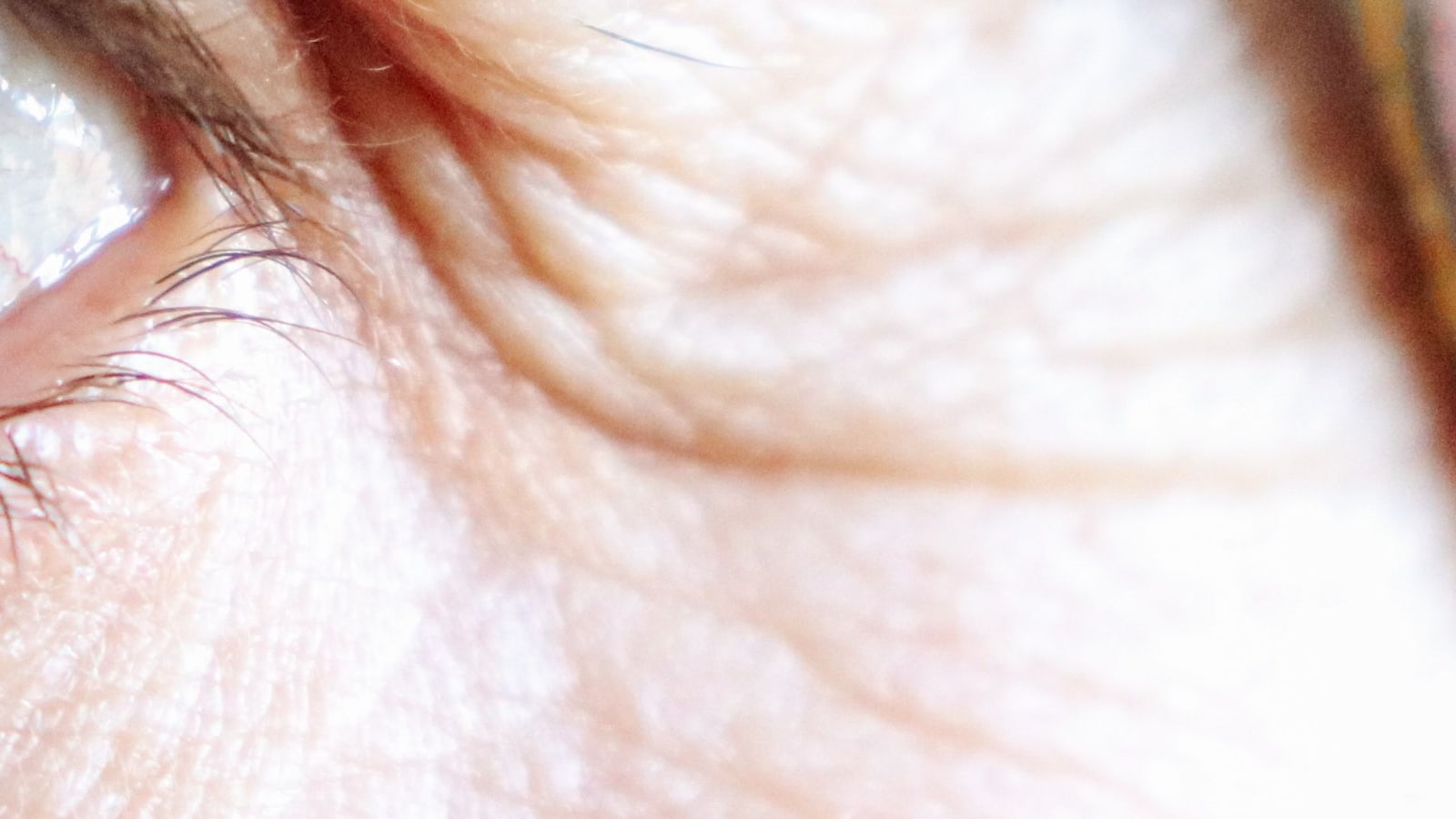
Lines that are present when your face is completely at rest. The AAD describes botulinum toxin as acting on targeted muscles: relaxing a muscle removes the fold that the muscle makes. Skin that has lost firmness is a different cause, and the AAD does not describe botulinum toxin as changing it.
The AAD describes the change from expression lines to lines present at rest in its guidance on skin during menopause: as collagen diminishes, wrinkles that used to appear only with a smile or frown become visible all the time (Caring for your skin in menopause). A line that is visible at rest is a skin-level change, and that is the situation in which treatments aimed at the skin, radiofrequency among them, come into the discussion.
If your injections are working on the lines that appear when you smile but fine lines remain when your face is still, both patterns are present, and that is when combining the two treatments comes up.
Radiofrequency after botulinum toxin: order and spacing when both are planned
No published patient guidance sets a waiting period between botulinum toxin injections and radiofrequency, so the order and the time between them are the clinician's decision.
The AAD's aftercare instruction after botulinum toxin is not to rub or massage the areas where you received the injections, and to wait two hours before strenuous physical activity. Cleveland Clinic describes radiofrequency tightening as a provider moving a hand-held electrode device over the treatment area, with the skin feeling warm while the device moves. Whether moving a handpiece over a recently injected area counts as the rubbing the AAD advises against is one of the things a clinician weighs in setting the order, so whether the injection comes first, second, or on a different day depends on your treatment plan; ask before booking.
Is there one right treatment for fine lines around the eyes?
There is no single best one, because the answer depends on which lines you have. Lines made by expression respond to treatments that relax the muscle. Lines present at rest are a skin problem, and skin-directed treatments apply to those. When both patterns are present at once, a combination comes up.
The side effect profiles also differ. For botulinum toxin, the AAD lists swelling, redness, soreness, and bruising as the usual effects, with weakness in a neighboring muscle leading to a temporarily droopy brow or eyelid as a rare one. For non-invasive skin tightening, the AAD reports usually some redness and swelling, but little risk of other side effects when performed by a board-certified dermatologist. Cleveland Clinic adds that in rare instances, extreme heat from radiofrequency can cause burns, and that provider experience matters.
Is what you see a line at all?
The two treatments above sort eye-area lines into two kinds. The AAD's guidance on skin after 50 names a third change that is neither, and it is common enough to check for before choosing anything.
The AAD writes that later in the process you may see pouches under your eyes, and that large pores also are due to lack of skin firmness. Neither is a line. A pouch is not an expression, so the muscle-directed treatment does not address it, and it is not a crease in thinned skin either. If what you notice in the mirror is a pouch rather than a line, name it separately at the consultation, because it is a separate item and neither source cited here describes either of these treatments for it.
Behind that loss of firmness the AAD gives two figures: women's skin loses about 30 percent of its collagen during the first five years of menopause, and then about 2 percent of its collagen every year for the next 20 years. It also says that as estrogen levels fall, skin becomes thinner, and thin skin bruises more easily. That last point bears on the injections. The AAD says the injections, rather than the botulinum toxin itself, cause most mild side effects, and that a bruise, if one appears, lasts about 1 week.
One practical difference between the two treatments sits in who may perform them. For the injections, the AAD's warning is specific: you should never get botulinum toxin injections at a non-medical spa, a party, a salon, or someone's home. For radiofrequency, Cleveland Clinic's list is wider and includes a medical spa, where the treatment may be given by a licensed aesthetician. Put the two lists side by side before agreeing to have both done in the same place.
This article is general information, not medical advice. Treatment suitability and results vary between individuals and are assessed by a qualified clinician.
Sources
- Cleveland Clinic. Radio Frequency (RF) Skin Tightening: Benefits & Dangers. Last updated 02/04/2023. https://my.clevelandclinic.org/health/treatments/24683-radio-frequency-rf-skin-tightening ↗
- American Academy of Dermatology. Botulinum toxin therapy: FAQs. https://www.aad.org/public/cosmetic/wrinkles/botulinum-toxin-faqs ↗
- American Academy of Dermatology. Many ways to firm sagging skin. https://www.aad.org/public/cosmetic/younger-looking/firm-sagging-skin ↗
- American Academy of Dermatology. Caring for your skin in menopause. https://www.aad.org/public/everyday-care/skin-care-secrets/anti-aging/skin-care-during-menopause ↗
- Chandra S, Mysore V, Shah S, Malayanur D, S R S. Physics of fractional microneedle radiofrequency – A review. Journal of Cutaneous and Aesthetic Surgery, 2024. https://pmc.ncbi.nlm.nih.gov/articles/PMC11497551/ ↗
- Zhang B, Tan X, Zhang Q, Wu M. The Landscape of Radiofrequency Technology for Skin Rejuvenation. Health Science Reports, 2026. https://pmc.ncbi.nlm.nih.gov/articles/PMC12743727/ ↗
Frequently asked questions
I am now getting botulinum toxin injections to improve the fine wrinkles around my eyes but can I combine with radio frequency treatments? What is the best treatment for that?
Yes, botulinum toxin injections and radiofrequency are combined in practice because they act on different tissue: the toxin relaxes the muscles that fold the skin, and radiofrequency heats the skin itself. Cleveland Clinic lists botulinum toxin injections among procedures a provider may schedule in the same appointment as radiofrequency tightening. One design question for the radiofrequency side is whether the device cools the skin surface while it heats the tissue beneath: a 2026 review describes surface cooling as a burn countermeasure for monopolar radiofrequency, with a trade-off against how deep the heat reaches, and neither it nor a review of radiofrequency physics compares cooled and uncooled devices around the eyes. There is no single best treatment, because expression lines and lines present at rest need different treatments, and the clinician who examines you decides whether combining them is appropriate for your eyes.
Should radiofrequency come before or after the injections?
No published patient guidance from the AAD or Cleveland Clinic sets an order or a waiting period, so no order is fixed in advance. Two facts are relevant: the AAD says not to rub or massage the injected areas afterward, and Cleveland Clinic describes radiofrequency as a handpiece moved over the skin. Ask which comes first and how much time should separate them.
How long do botulinum toxin and radiofrequency results last for periocular wrinkles?
The AAD says the effect of botulinum toxin lasts about 3 to 4 months, sometimes longer, and that you can have another treatment when the lines return. For non-invasive radiofrequency, the AAD says most people feel some tightening right away, see the fullest result at about 6 months, and that results can last 2 to 3 years with the right skin care. Those radiofrequency figures describe the treatment category, not the eye area specifically.
What are the safety points and side effects of botulinum toxin and radiofrequency for periorbital wrinkles?
For botulinum toxin injections, the AAD lists swelling, redness, soreness, and bruising, with a temporarily droopy brow or eyelid from weakness in a neighboring muscle as rare. For non-invasive skin tightening, the AAD reports usually some redness and swelling and little risk of other side effects when performed by a board-certified dermatologist, and Cleveland Clinic notes rare burns from extreme heat.
Which lines around the eyes does botulinum toxin not fix?
The AAD describes botulinum toxin as acting on targeted muscles, so lines that are visible when your face is completely at rest, which reflect a change in the skin, are not what it addresses. Relaxing a muscle removes the fold that the muscle makes, but the AAD describes how, as collagen diminishes, wrinkles that used to appear only with a smile or frown become visible all the time. Those lines are a change in the skin itself, and skin-directed treatments are discussed for them.
This content is for general information only and does not guarantee the results of any treatment. Any treatment decision should be made in consultation with a qualified medical professional.