Are Radiofrequency Skin Treatments Really Effective? What the Published Guidance Says

Key Takeaways
- The AAD describes the result of non-invasive skin tightening, radiofrequency included, as modest tightening and lifting that appears gradually. It describes surgery as the option with the most dramatic results.
- Radiofrequency heats the tissue beneath the skin. The heat comes from the tissue's own electrical resistance to the current, and the body's response, new collagen, takes months to show.
- Devices differ in how they deliver and control the current: whether each shot is one continuous pulse or a train of pulses, and whether the device reads the skin's resistance, called impedance. Neither is evidence of effectiveness; both are questions about which design of "radio frequency" a clinic offers.
- Timing matters for judging effectiveness: the AAD puts the fullest radiofrequency result at about 6 months, and Cleveland Clinic at two to six months.
- The amount of sagging at the start is the factor the AAD names for who benefits most. A small amount of sagging is likely to respond; lots of sagging may not be helped.
Radiofrequency is one of the non-invasive skin tightening treatments described in the patient guidance of the American Academy of Dermatology (AAD), and whether it works has a specific answer there: a limited result, with a size, a timing, and conditions attached.
Do radiofrequency skin tightening treatments really work?
Yes, for a limited amount of tightening, according to the AAD. The AAD's patient guidance on skin tightening groups non-invasive procedures, which include radiofrequency, under the heading of modest tightening and lifting, and describes their results as tending to appear gradually, so they seem natural (Many ways to firm sagging skin). For radiofrequency specifically it says most people have one treatment and feel some tightening right away, that the fullest results come at about 6 months, and that results can last 2 to 3 years with the right skin care.
Cleveland Clinic's guidance says the same thing with slightly different numbers: changes in skin tone and appearance within two to six months, some people needing two to six treatments, and effects that may last one to three years with proper skin care (Radio Frequency (RF) Skin Tightening: Benefits & Dangers).
The AAD also describes the upper limit of what tightening can do: a surgical lift gives the most dramatic results, and even minimally invasive procedures cannot match a facelift. Radiofrequency is used for a smaller change than surgery produces, and the AAD's figures describe that smaller change.
What does radiofrequency do to the skin?
It heats the tissue beneath the skin's surface, and the body responds to that heat over the following months. The AAD describes the procedure as a dermatologist placing a device against the skin, which heats the tissue beneath, and explains that the heat can cause the body to produce more collagen.
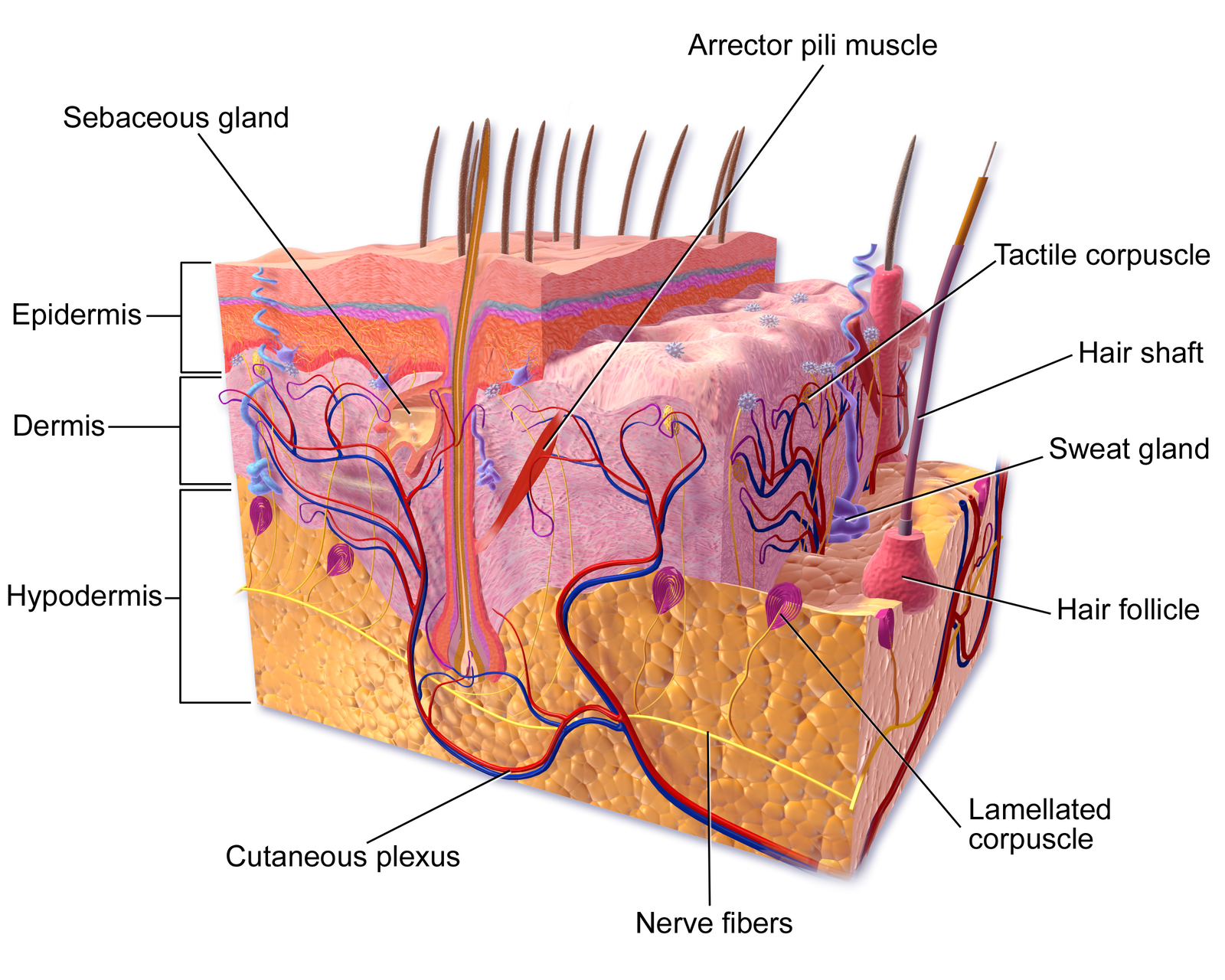
Illustration: Blausen.com staff (2014), WikiJournal of Medicine, CC BY 3.0, cropped. It shows the layers of the skin, not this or any treatment.
Radiofrequency is an alternating electrical current, and tissue resists the flow of that current. A clinical reference on electrosurgery describes the principle: the electrical resistance of soft tissue to an electromagnetic current generates heat, and because skin conducts poorly, the energy builds up and is converted into heat (Electrosurgery). That reference covers surgical uses of the same physics, such as controlling bleeding, rather than cosmetic tightening, and the settings differ, but the source of the heat is the same in both.
How that current is delivered and controlled differs between devices, and it is part of what "radio frequency" means at a given clinic. In needle-based radiofrequency, a review of radiofrequency physics describes two generator modes: single-pulse mode, in which one energy wave passes into the skin when the switch is pressed, and repeat mode, in which several waves are passed during the "on" time (Physics of fractional microneedle radiofrequency – A review). In a laboratory study on rat skin with needle electrodes, dividing the same energy into more pulse packs with shorter conduction times changed where the tissue coagulated: less beside the electrodes and more in the tissue between them (Immediate and Late Effects of Pulse Widths and Cycles on Bipolar, Gated Radiofrequency-Induced Tissue Reactions in in vivo Rat Skin). Neither source measured cosmetic results in people or judged one pattern better; what they show is that the pulse pattern is one variable in how heat is deposited.
The second variable is how the device reads the tissue. Skin resists current differently from person to person and from area to area, and the energy delivered depends on that resistance, called impedance: a 2026 review states the relationship as energy equal to current squared multiplied by impedance and time (The Landscape of Radiofrequency Technology for Skin Rejuvenation). Some devices read it: the review of radiofrequency physics notes that newer devices come with impedance-sensing tips that warn the operator about the selected energy delivery, and it does not compare results with and without sensing. Neither pulse pattern nor impedance sensing is evidence that a treatment works; the AAD figures above are that evidence. What the two tell you is which design of "radio frequency" a clinic is offering.
The collagen response is why the timeline is measured in months. Cleveland Clinic states the reason directly: it takes time for the skin to produce new skin cells, collagen, and elastin, so changes appear within two to six months rather than at the end of the session.
Radiofrequency skin tightening efficacy: what a 2026 systematic review and the randomized trial evidence report
A modest firming of the same face that appears gradually over months. The AAD's description of non-invasive results as gradual and natural-looking is the realistic expectation, and its word for the size of the change is modest.
Three points from the AAD's guidance matter when you judge a result. The immediate feeling of tightening that most people notice after radiofrequency is not the final result; the fullest change comes at about 6 months. The AAD describes the category, so its figures say nothing about any one clinic's device. And the duration figure of 2 to 3 years is conditional on the right skin care; the AAD's conditions for good results on the same page are sun protection, not smoking, and a healthy weight.
In study terms, the 2026 review in Health Science Reports, which describes its method as a systematic review of the PubMed and Web of Science databases, tabulates the clinical studies behind each type of radiofrequency. The designs range from randomized clinical trials to non-randomized, unblinded series, and the review closes by calling for randomized controlled trials with larger sample sizes and longer follow-up to validate the long-term efficacy and safety of radiofrequency treatments (The Landscape of Radiofrequency Technology for Skin Rejuvenation). That is the same size of claim the AAD makes with the word modest: a real but limited result, with the strongest study designs still to come.
Why do results differ so much between people?
Because the starting point, the treatment type, and the operator all vary.
- Amount of sagging. The AAD says you are likely to benefit most if you have a small amount of sagging skin, and that if you have lots of sagging skin, skin tightening may not be helpful. Two people can have the same treatment and describe opposite results for this reason alone.
- Type of radiofrequency. The AAD lists two categories. Non-invasive radiofrequency is applied from the surface, with little or no downtime and results at about 6 months. Minimally invasive radiofrequency delivers heat through a thin tube or needles under the skin, requires a few days of downtime, and shows results in about 1 month. A result reported for one category does not tell you much about the other.
- Operator and settings. Cleveland Clinic says it is important to choose a provider who has experience with radiofrequency treatments, and the AAD's low side-effect profile is conditioned on the procedure being performed by a board-certified dermatologist.
- Skin care afterward. Both sources tie how long the result lasts to skin care, and the AAD's conditions for good results include sun protection, not smoking, and maintaining a healthy weight.
Is one radiofrequency treatment enough?
Often, but not always. According to the AAD, most people have one radiofrequency treatment, and some people benefit from having more than one. Cleveland Clinic says some people need two to six, and that if you do not get the result you wanted, your provider may recommend another treatment.
Neither source sets a schedule. Because the result develops over months, Cleveland Clinic describes another treatment being recommended if the result you wanted has not appeared, which places the decision after the result of the earlier session rather than on a fixed count.
How many treatments you need depends on which kind of radiofrequency it is
A 2026 review lists one to two sessions for one kind of radiofrequency and three to six for another.
The AAD and Cleveland Clinic both describe radiofrequency as a single category. The review in Health Science Reports sorts it a second way, by how many electrodes carry the current: "Currently, RF can be based on the number of electrodes, which can be divided into monopolar RF, bipolar RF, and multipolar RF." Its comparison table gives each a depth, a session count, the uses it is listed for, and a limitation.
| From the review's comparison table | Monopolar | Bipolar | Multipolar |
|---|---|---|---|
| How deep the energy reaches | Up to 20 mm | 1.0 to 4.0 mm | 0.5 to 3.0 mm |
| Typical sessions | 1 to 2 | 3 to 6 | 3 to 4 |
| Listed as used for | Moderate to severe skin laxity, periorbital wrinkles, facial contouring | Mild to moderate skin laxity, texture improvement, melasma, home-use devices | Acne scars, photoaging, enlarged pores |
| Limitation named | Higher pain perception | Limited depth efficacy | Risk of pinpoint bleeding |
Figures from Table 1 of The Landscape of Radiofrequency Technology for Skin Rejuvenation, Health Science Reports, 2026. The row labels are plain-English versions of the review's own.
Two cautions about reading that table. It covers radiofrequency systems across the field, microneedle ones included, so its rows do not line up one to one with the AAD's split into non-invasive and minimally invasive. And a listed use is what published studies have applied a configuration to, not a statement of how well it worked. What the table does show is that a session count is tied to the configuration in front of you rather than to radiofrequency as one thing. The review closes on the same point: radiofrequency "efficacy depends critically on the customization of treatment parameters and the expertise of the practitioner."
This article is general information, not medical advice. Treatment suitability and results vary between individuals and are assessed by a qualified clinician.
Sources
- American Academy of Dermatology. Many ways to firm sagging skin. https://www.aad.org/public/cosmetic/younger-looking/firm-sagging-skin ↗
- Cleveland Clinic. Radio Frequency (RF) Skin Tightening: Benefits & Dangers. Last updated 02/04/2023. https://my.clevelandclinic.org/health/treatments/24683-radio-frequency-rf-skin-tightening ↗
- Baigrie D, Qafiti FN, Buicko Lopez JL. Electrosurgery. StatPearls, NCBI Bookshelf. Last update May 22, 2023. https://www.ncbi.nlm.nih.gov/books/NBK482380/ ↗
- Chandra S, Mysore V, Shah S, Malayanur D, S R S. Physics of fractional microneedle radiofrequency – A review. Journal of Cutaneous and Aesthetic Surgery, 2024. https://pmc.ncbi.nlm.nih.gov/articles/PMC11497551/ ↗
- Kim HK, Kim H, Kim JY, Ban MJ, Son J, Hwang Y, Cho SB. Immediate and Late Effects of Pulse Widths and Cycles on Bipolar, Gated Radiofrequency-Induced Tissue Reactions in in vivo Rat Skin. Clinical, Cosmetic and Investigational Dermatology, 2023. https://pmc.ncbi.nlm.nih.gov/articles/PMC10053894/ ↗
- Zhang B, Tan X, Zhang Q, Wu M. The Landscape of Radiofrequency Technology for Skin Rejuvenation. Health Science Reports, 2026. https://pmc.ncbi.nlm.nih.gov/articles/PMC12743727/ ↗
Frequently asked questions
Are radio frequency treatments really effective?
Yes, for a limited amount of tightening: the American Academy of Dermatology describes non-invasive radiofrequency as producing modest, gradual tightening of mildly loose skin, and it reports that most people have one treatment, feel some tightening right away, and see the fullest result at about 6 months, with results lasting 2 to 3 years with the right skin care. The result is smaller than surgery, and the AAD says tightening may not help lots of sagging skin.
How long does it take to see results from radiofrequency?
The AAD says most people feel some tightening right away but see the fullest result at about 6 months, because the body needs time to make collagen. Cleveland Clinic gives a window of two to six months for visible change in skin tone and appearance. Before then, the collagen response has not finished, so there is little to judge.
Is radiofrequency skin tightening a substitute for a facelift?
No. The AAD describes a surgical lift as giving the most dramatic results and non-invasive procedures such as radiofrequency as giving modest tightening and lifting; it also notes that even minimally invasive procedures cannot match the results of a facelift. Radiofrequency is discussed for a small amount of sagging, in the AAD's wording, not as an alternative to surgery for significant sagging.
Why do results vary from person to person?
The AAD names the amount of sagging as the main factor: a small amount of sagging is likely to respond, while lots of sagging may not be helped. Beyond that, non-invasive and minimally invasive radiofrequency are different categories with different timelines, results depend on the operator's experience and settings, and how long the change lasts depends on sun protection, smoking, and weight.
What side effects are reported after radiofrequency skin tightening?
After non-invasive radiofrequency tightening, the AAD reports usually some redness and swelling, with little risk of other side effects when the procedure is performed by a board-certified dermatologist. Cleveland Clinic says mild redness and swelling should go away within 24 hours and that, in rare instances, extreme heat from radiofrequency can cause burns, which is why it advises choosing an experienced provider.
This content is for general information only and does not guarantee the results of any treatment. Any treatment decision should be made in consultation with a qualified medical professional.