Are Fine Lines Just Dry Skin? What Causes Them, and Why the Eye Area Shows Them First

Key Takeaways
- Fine lines start in the dermis, in repeated folding by the expression muscles, and in years of sun. The water held in the outer layer changes how sharply the line reads.
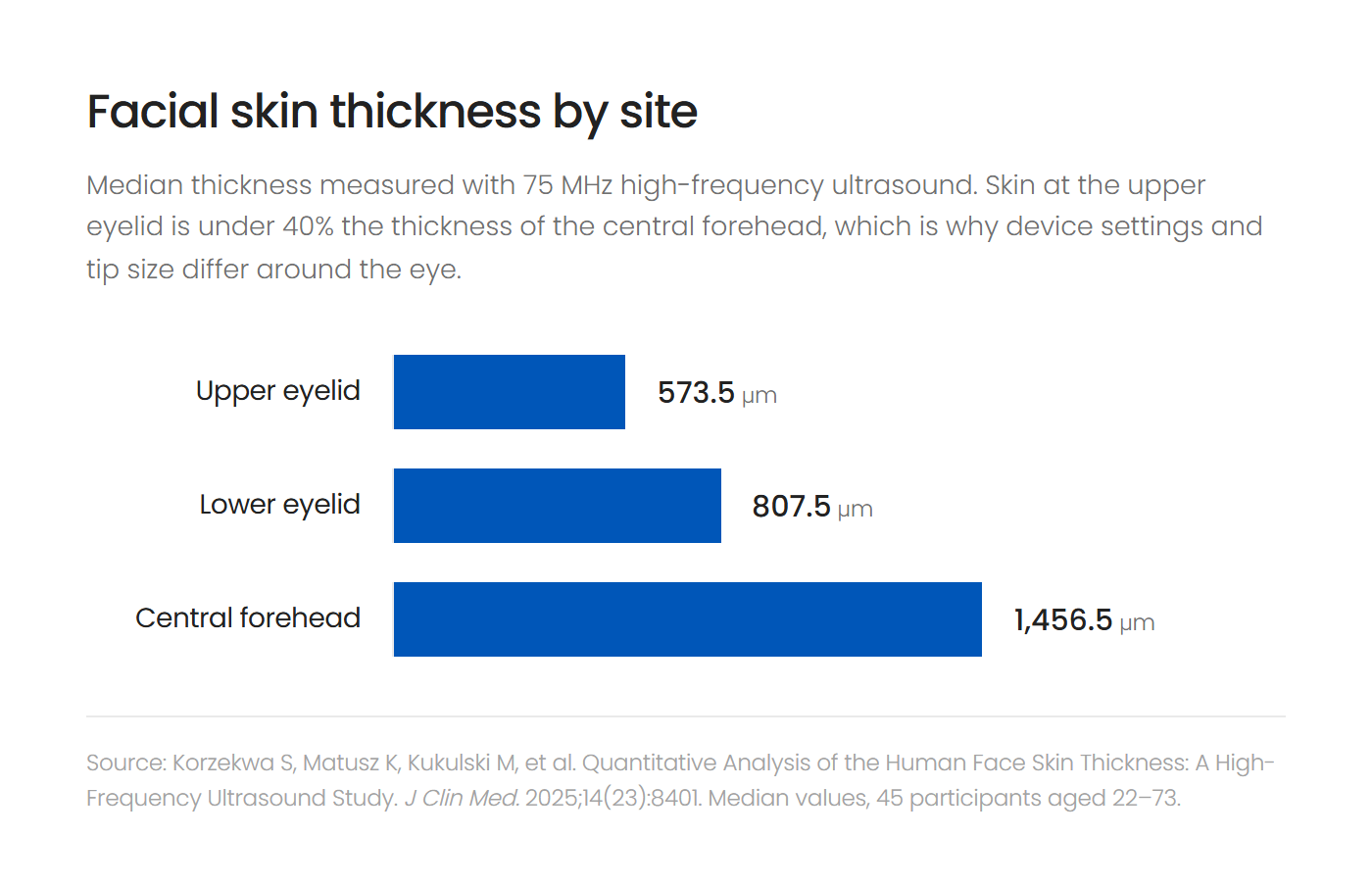
- The skin around the eye is the thinnest on the face. Published ultrasound medians put it at 573.50 μm on the upper eyelid, against 1,456.5 μm in the forehead region.
- Lines running out from the outer corner and the fine lines under the lower lid start in different ways.
- A hollow under the eye casts a shadow, and a shadow can read as a line where the skin is unchanged.
What forms a fine line, and what dryness changes
A fine line comes from change in the dermis underneath, from the expression muscles folding the same piece of skin in the same direction over and over, and from years of accumulated sun exposure.
How much water the outer layer of the skin holds changes how sharply that fold reads. When it holds less, the same fold reads as a sharper line, and when the water comes back the line reads as softer again.
All of that happens across the face, and around the eye it becomes visible earlier than anywhere else.
Which change is doing the most in a given face, and what if anything should be done about it, is a clinical assessment.
Why the skin around the eyes lines first
It is the thinnest skin on the face, and the difference has been measured.
A high-frequency ultrasound study measured 38 sites across the faces of 45 women. The median came to 573.50 μm at the upper eyelid and 807.5 μm at the lower eyelid, against 1,456.5 μm in the forehead region (Korzekwa et al., J Clin Med, 2025).
Less tissue covers everything underneath it there. A change of the same size therefore reaches the surface earlier around the eye than it does where the skin is thicker.
Why crow's feet come and go but under-eye lines stay
The muscle that closes the eye folds the same skin in the same direction every time you smile or squint. Early on the fold is only there while the muscle is working, and the line goes when the face relaxes.
As the dermis loses the springiness that returns it to its original shape, the fold stops resolving completely. What was a line only during expression becomes a mark that is there at rest.
The fine lines under the lower lid arrive by another route. They come from change in the skin itself, so they spread as a fine crepey mesh with no single direction, and they are visible at rest from the beginning.
| Crow's feet | Under-eye fine lines | |
|---|---|---|
| Starting point | Repeated folding by the muscle that closes the eye | Change in the skin itself |
| Appearance | Lines running out from the outer corner | Fine crepey mesh, no single direction |
| At rest | Fade early on, remain later | Visible from the start |
Why the area under the eye can look hollow rather than lined
Volume under the lower lid can drop, and the groove that leaves throws a shadow. That shadow reads as a line even where the skin over it is unchanged.
The fat that sits around the eye socket and the structures holding it in place are not the same at fifty as at twenty-five, and the outline of the bone below the lid becomes easier to see as they shift. None of that involves the skin folding.
Two things that look alike at the surface can begin in different places, and the difference is not settled by looking at a photograph.
Volnewmer: device facts
Volnewmer is a monopolar radiofrequency device made by CLASSYS. It operates at 6.78 MHz and is licensed in Korea as a general-purpose electrosurgical device.
Three points about how it is built:
- The system takes four tips, with contact areas of 0.25, 3.0, 4.0 and 16.0 cm². The smallest of them is the I Tip at 0.25 cm².
- Water cooling circulates through the handpiece without interruption. Six settings run from OFF to 12°C, and the chosen temperature is maintained across the pass, whether or not energy is being delivered at that moment.
- Automatic impedance measurement reads the skin's electrical resistance before cooling and energy delivery begin. The tip head tilts through a full 360°.

Everything above describes how the device is built. None of it is a claim about what it achieves. Whether radiofrequency is appropriate for a given person, and at what settings, is decided by a physician.
What is reported to go wrong around the eyes
Redness, mild swelling, needle marks, bruising, and flaking after resurfacing are reported after energy-based and injection treatments, and they settle on their own.
Burns from thermal energy, changes in pigment, and temporary changes in sensation are also reported. An injection placed close to the lower lid can leave the lid or the brow temporarily drooping. One case series reviewed ten patients who came to a laser clinic with adverse events after non-invasive radiofrequency for cosmetic use: seven had first- or second-degree burns, and three had persistent erythema with increased skin sensitivity (Chung and Lee, Med Lasers, 2015). The sister article to this one covers what has been reported to go wrong around the eye in more detail.
Some circumstances change what the clinician decides rather than what the patient decides. Pregnancy, an implant or an electronic medical device sitting in the area, thin or reactive skin, and active inflammation are among the things weighed at the examination, where the outcome may be a different setting or a postponed session.
Results and timing vary between individuals. Each clinic sets its own price, which varies by country and by how much area is treated, so check it with the provider directly.
Volnewmer is a general-purpose electrosurgical device that uses radiofrequency current for coagulation of tissue. This product is a medical device. Read the instructions for use and the precautions before use. Treatment suitability must be determined by a qualified physician.
Sources
- Korzekwa S, Matusz K, Kukulski M, et al. Quantitative Analysis of the Human Face Skin Thickness: A High-Frequency Ultrasound Study, J Clin Med. 2025;14(23):8401. https://pmc.ncbi.nlm.nih.gov/articles/PMC12693017/ ↗
- Chung JY, Lee JH. Adverse Events after Noninvasive Radiofrequency Treatment for Cosmetic Uses, Med Lasers. 2015;4(1):16-19. https://doi.org/10.25289/ML.2015.4.1.16 ↗
Frequently asked questions
Are fine lines on the face the result of dry skin? What causes them?
Fine lines form from change in the dermis, from the expression muscles folding the same piece of skin in the same direction over years, and from accumulated sun exposure. How much water the outer layer of the skin holds changes how sharply that fold reads: when it holds less the same fold reads as a sharper line, and when the water returns the line softens again. This shows around the eye before the rest of the face, where the skin measures a median 573.50 μm on the upper eyelid against 1,456.5 μm in the forehead region. Sorting out which of those changes is doing the most in one person's face is a physician's assessment.
Why do wrinkles show up around the eyes before the rest of the face?
It is the thinnest skin on the face, and the measurements are published. The numbers come from a high-frequency ultrasound study of 45 women covering 38 facial sites, which reported medians of 573.50 μm for the upper eyelid, 807.5 μm for the lower eyelid, and 1,456.5 μm for the forehead region. Less tissue covers what lies beneath, so a change of the same size reaches the surface earlier there than it does where the skin is thicker.
Why do crow's feet stay visible even when I'm not smiling?
Because the muscle is no longer the only thing making that fold. Early on the line appears while the muscle that closes the eye is working and goes when the face relaxes. As the dermis loses the springiness that returns it to its original shape, the fold stops resolving completely, and what was visible only during expression becomes a mark that is there at rest.
Are the hollows under my eyes the same thing as wrinkles?
No. A hollow casts a shadow, and a shadow can read as a line even where the skin itself is unchanged. Volume under the lower lid and the structures holding it in place are not the same at fifty as at twenty-five, and the groove that leaves is a different thing from skin that has been folded repeatedly. The two look alike at the surface, so which one is present is distinguished at the examination rather than from a photograph.
Why is the eye area handled more carefully than the rest of the face?
The skin covering it is the thinnest on the face, so the same stimulus shows up more there. Reactions reported after energy-based and injection treatments include redness, mild swelling, needle marks, bruising, and flaking after resurfacing, all of which settle on their own. Also reported are burns from thermal energy, changes in pigment, temporary changes in sensation, and a temporarily drooping lid or brow after an injection placed close to the lower lid.
This content is for general information only and does not guarantee the results of any treatment. Any treatment decision should be made in consultation with a qualified medical professional.